

A teacher we read regularly, Michael Linsin, published a piece last year arguing that students should do their independent reading from physical books rather than screens. His case is forceful and his instinct matches ours. Our students read paper books.
So we went looking for the research behind it, expecting to find support for a practice we already follow.
What we found was more complicated, and more interesting, and it changed how we’d defend our own position. It seemed worth writing up honestly rather than quietly filing away.
What the evidence actually shows
The main body of work here is a set of meta-analyses, which pool many individual studies to find what holds up across all of them.
The most cited is by Pablo Delgado and colleagues at the University of Valencia in Spain, with Rakefet Ackerman at the Technion in Israel, published in 2018. They gathered 54 studies comparing reading comprehension on paper against screens.
They found a genuine advantage for paper. It’s small. In the standard measure it comes to about −0.21, which is roughly two thirds of the reading growth a typical elementary student makes in a year. Not nothing, and not the gulf the popular version suggests.
The more important detail is how uneven it is. The variation between studies was high enough that the authors’ own range of expected effects crosses zero, meaning there are populations where reading on a screen would come out ahead. Their phrasing is that the effects are large in some populations and trivial in others.
The finding that matters most to us
Delgado’s team tested what changes the size of the effect. One moderator stood out.
Text genre. For informational text, the paper advantage was clear at −0.27. For narrative text, it was +0.01. That is to say, none at all.
Virginia Clinton at the University of North Dakota found the same pattern independently in 2019: expository text −0.32, narrative −0.04. A larger 2022 analysis by Schwabe and colleagues, working with roughly five times the narrative material of either, found no screen disadvantage for narrative text whatsoever. Their paper is titled, with admirable directness, “No Negative Effects of Reading on Screen on Comprehension of Narrative Texts.”
This matters here because a Charlotte Mason education runs on living books, and living books are overwhelmingly narrative. Story, biography, history told as a life rather than a list.
Which means the comprehension research, read carefully, does not support the thing we might have liked it to support. For our kind of reading, the evidence says the medium makes little measurable difference.
Two further findings work against the intuitive version. The effect is not worse for younger children, which surprised us; Delgado found no difference by age at all, and a 2023 follow-up from the Valencia group found school-age children showed no disadvantage on tablets and e-readers. And the effect on handheld devices runs at about half what it does on desktop computers.
What we won’t repeat

Linsin’s piece states that reading on a laptop raises a student’s biological stress response and anxiety level, as screen time is “proven to do.”
We can’t find support for that, and there’s evidence pointing the other way. A German team led by Anne Kretzschmar ran EEG and eye-tracking on adults reading from paper, an e-reader and a tablet. Comprehension didn’t differ, and no physiological measure suggested screen reading took more effort. For older readers the tablet was marginally easier. Their conclusion was that the widespread belief digital reading is more taxing is cultural rather than cognitive.
We mention it because we nearly repeated it. It’s a satisfying claim and it appears in a lot of places. Following it back, it seems to originate in a summary that recast a study measuring something else. Once we could see that, we couldn’t print it.
So why do we still use paper books
Because the case was never really about comprehension scores.
The most robust finding in this whole literature isn’t about how much readers understand. It’s about how much they think they understand. Clinton’s analysis found that readers on screens are measurably more overconfident, judging their own grasp of a text less accurately than readers on paper.
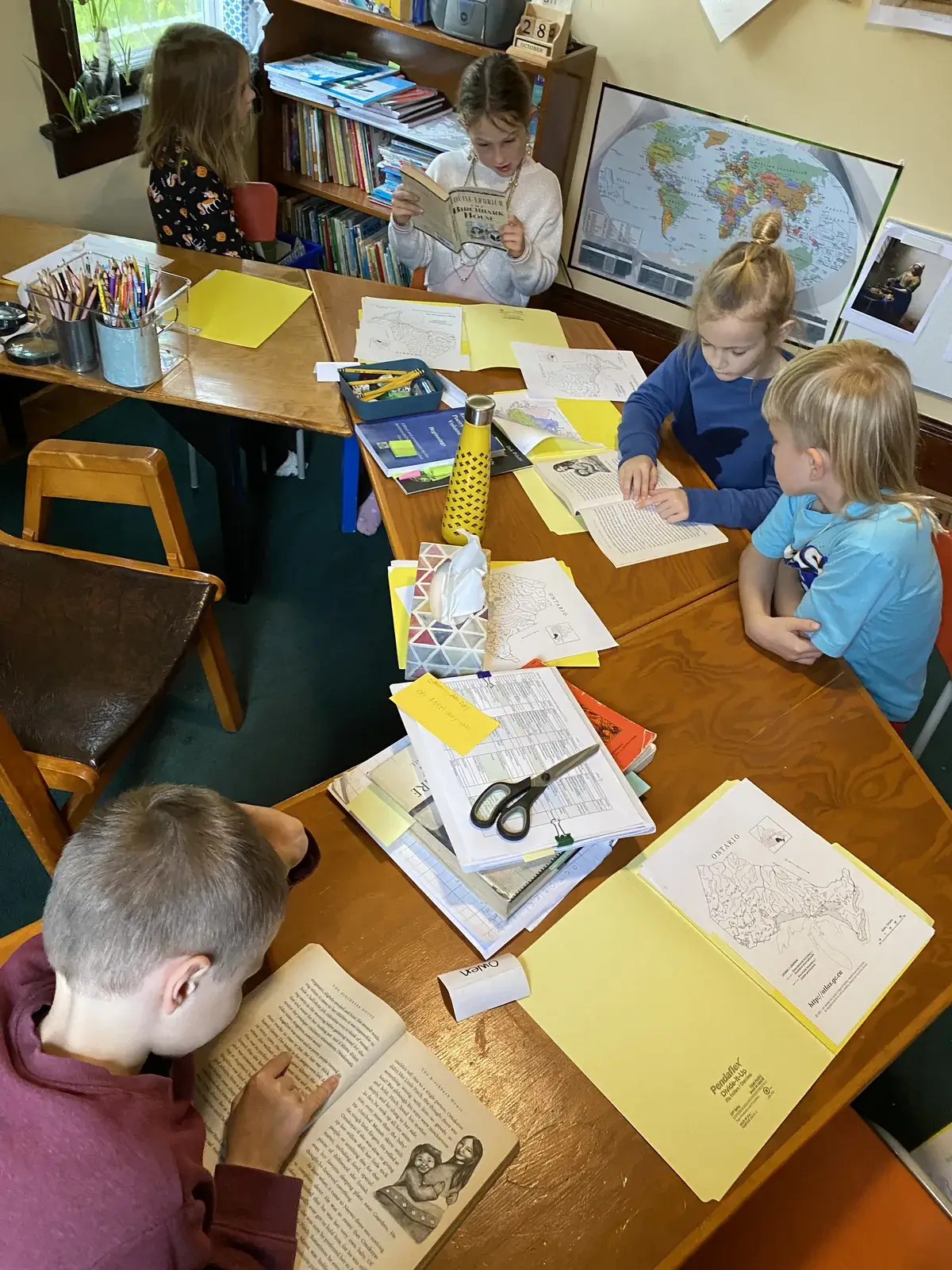
That’s the finding with teeth for us, because of how our classrooms work. After a child reads, they narrate: they tell back what happened, in their own words, with the book closed. Narration is precisely a test of whether the reading actually landed. A child who skimmed and felt fine cannot narrate, and both of us find out inside a sentence.
Narration is a check against exactly the overconfidence the research identifies, whatever the child read from.
The other reasons are plainer, and none of them require a study. A physical book doesn’t notify you. It has no second tab. A ten-year-old holding one has made a single decision about what they’re doing for the next half hour, rather than renewing that decision against competition every few minutes.
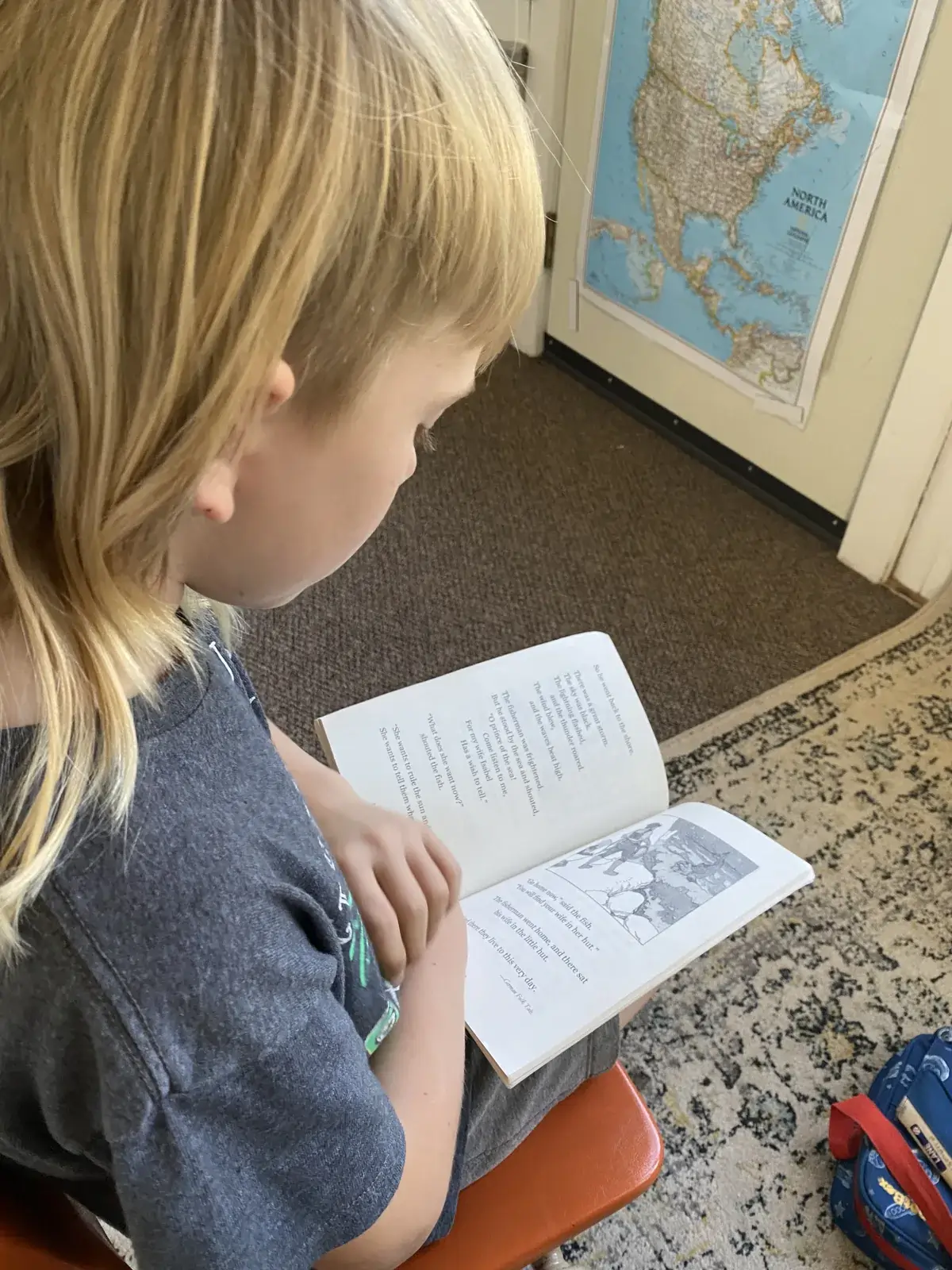
In practice the choice doesn’t really come up during our school day. We don’t issue Chromebooks and phones are away, so independent reading happens from a book because a book is what’s there. The research above is why we’re comfortable with that rather than uneasy about it.
And there’s a difference between reading a book and being read to by software. A programme that narrates aloud while a child follows along is doing a share of the work the child needs to do themselves. That was Linsin’s sharpest point, and it stands regardless of what the medium research says.
A gap worth naming
One last thing, and it’s the sort of absence a Canadian parent should know about.
There is essentially no Canadian research on this. The evidence above is Spanish, Israeli, American, German and Norwegian. In 2021, four provinces sat the digital version of the world’s main international reading assessment alongside paper comparison samples, and no Canadian result on the difference was ever published. Ontario withdrew from that round entirely.
So when anybody tells you what screens are doing to Canadian children’s reading, ask where the Canadian number came from. As far as we can establish, there isn’t one.
The piece that started this
Why Your Students Should Read Books, Not Screens, Michael Linsin, Smart Classroom Management.
We’d still recommend reading it. He’s a teacher of thirty years writing about what he sees in classrooms, and on read-along software he’s right. We just wouldn’t lean on the research the way the article does, and we thought you’d rather have that from us than find it out later.
Ready to learn more about how WONDERfield Community School can nurture your child’s love of learning? We’d love to share more about our approach and answer your questions. Visit our contact page to schedule a school tour or chat with our team about your family’s educational journey.