

Jonathan Haidt gave a TED talk this year on what happened to childhood when it moved onto screens. If you’ve been anywhere near a conversation about phones and teenagers lately, you’ve probably encountered his name.
We’re recommending the talk to our families. Not because it flatters how we teach, though it does in places, but because the questions he raises are ones every parent choosing a school is entitled to ask us directly.
What he actually argues
Haidt teaches at New York University and studies moral and social psychology. His starting point is that humans are an intensely social species with real needs for community, and that a phone-based childhood substitutes a thin version of connection for a thick one.
His phrase for it is that quantity pushes out quality. A teenager can have hundreds of interactions a day and still arrive at adulthood without much practice at the harder kind: sustained, in-person, with someone who can see their face.
He then makes a claim that matters more for schools than for parents. The damage isn’t only social. Constant switching degrades the ability to hold attention on one thing for a long stretch, and puberty is a particularly costly time to lose that ability, because it’s when the brain is doing a lot of its wiring.
His third strand concerns classroom technology directly. He points at national test scores falling after schools rolled out one device per child, and at Sweden, which digitised its classrooms and then reversed course in 2023.
Three principles, not a list of rules
What he offers isn’t a checklist. It’s three principles for what he calls techno-skepticism.
The first is to protect brain development through puberty. The second is to prioritize people and books in education rather than screens. The third is to be wary of artificial relationships for young people, meaning AI companions and chatbots that simulate friendship.
The second one is a description of a Charlotte Mason classroom, written by someone who wasn’t thinking about Charlotte Mason at all.
Where our method already lands
We should be careful here, because it would be easy to claim more than we’ve earned.
WONDERfield’s approach predates this debate by more than a century. Mason was writing in England between the 1880s and the 1920s, and nothing she designed was a response to smartphones. That our method happens to sit where Haidt is pointing is a coincidence of first principles, not foresight.
But the overlap is real, and it’s worth naming.
Our students learn from living books, which is to say whole works of real literature rather than textbook extracts. They narrate what they’ve read, telling it back in their own words, out loud or in writing. That’s an attention task with nowhere to hide: a child who read while half-present cannot narrate, and it shows within a sentence.
Lessons are short, roughly 20 to 30 minutes, and there are many of them across a wide range of subjects. The design assumes a child’s attention is finite and worth spending carefully.
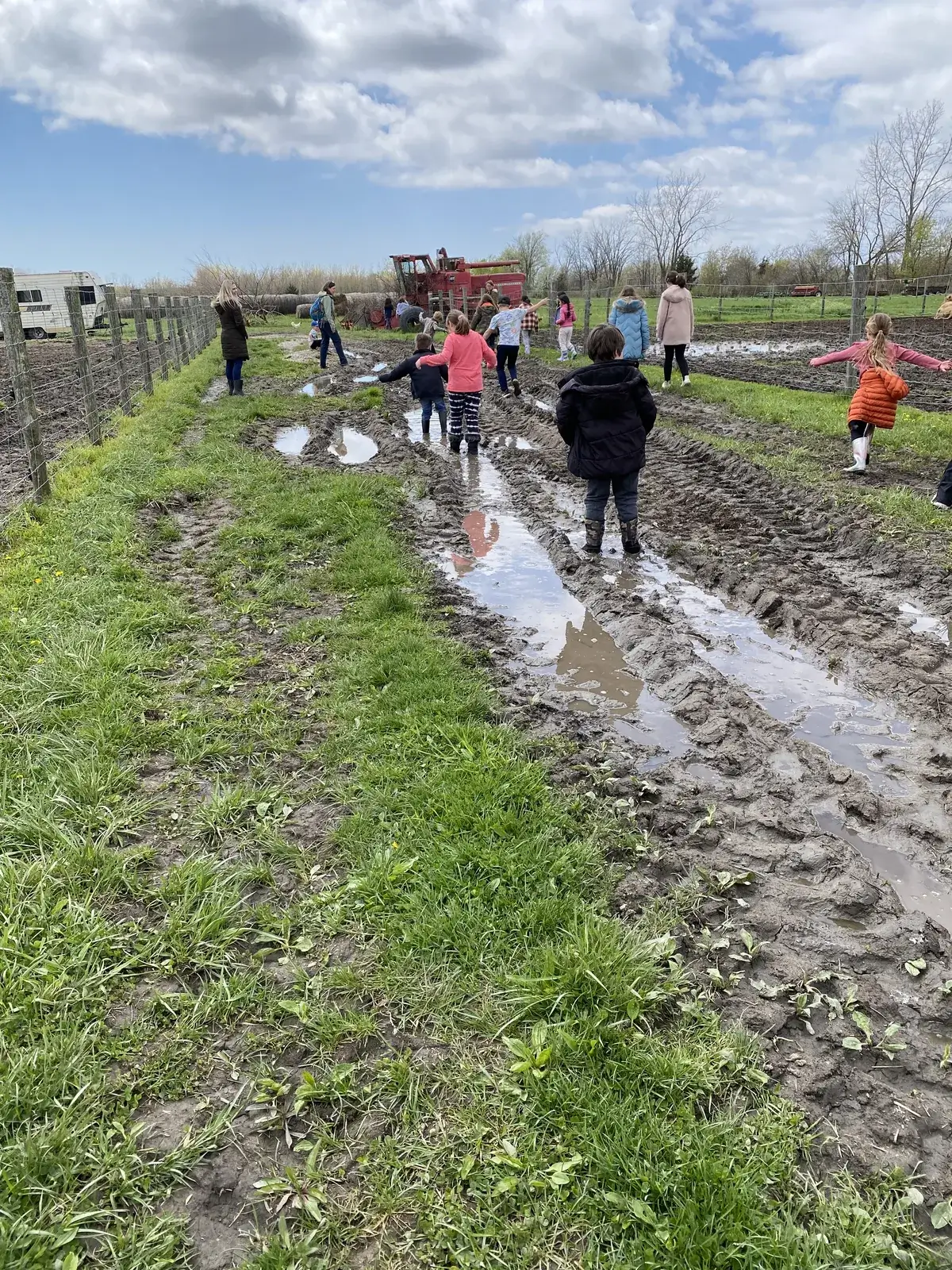
They’re outside every day. They do handwork with real tools in woodshop, fabric art and the kitchen, on projects that take weeks. Our multi-age forms mean a child spends the day among children of different ages who they cannot mute or scroll past.
None of that was built as an antidote to anything. It just turns out that a school organised around books, conversation, handwork and being outdoors looks a lot like what a critic of screen-based childhood would ask for.
The part that isn’t a coincidence
There’s one exception, and it’s a deliberate one.
The pedagogy is a century old. Our approach to devices is a decision we make now, with this whole debate in full view. Phones are away during school hours. We don’t issue Chromebooks, and we don’t put a screen in front of each child to work behind.
That isn’t a screen-free classroom, and we won’t pretend it is. A teacher will sometimes bring their own computer to the front to show the class something that genuinely helps an idea land: a piece of music, a map, a photograph, a short clip. Then it goes away again. The distinction we hold to is that no child spends the day alone with a device.
Haidt’s third norm, in the version aimed at schools, is simply phone-free schools. On the school-hours side, that’s already how we run.
What we’d rather you asked us
Reading a talk like this and then touring schools, the useful question isn’t whether a school has technology. It’s what the school thinks attention is for, and what it does on a Tuesday to build it.
Ask us what a lesson looks like. Ask what happens when a child hasn’t done the reading. Ask how much of the day is spent making something, or outside, or talking to another person about a book. Those answers tell you more about a school’s real position than a policy document will.
Watch it yourself
The talk is free, publicly available, and considerably better than any summary of it, including this one.
How screens stole childhood, and how to get it back, Jonathan Haidt, TED.
Two honest caveats. His numbers are drawn largely from American data, so a Canadian parent should read them as the direction of a trend rather than a measurement of our own children. And he’s arguing a case rather than presenting a neutral survey, which is worth holding in mind even where you find him persuasive. We’d rather hand you that than pretend otherwise.
Ready to learn more about how WONDERfield Community School can nurture your child’s love of learning? We’d love to share more about our approach and answer your questions. Visit our contact page to schedule a school tour or chat with our team about your family’s educational journey.